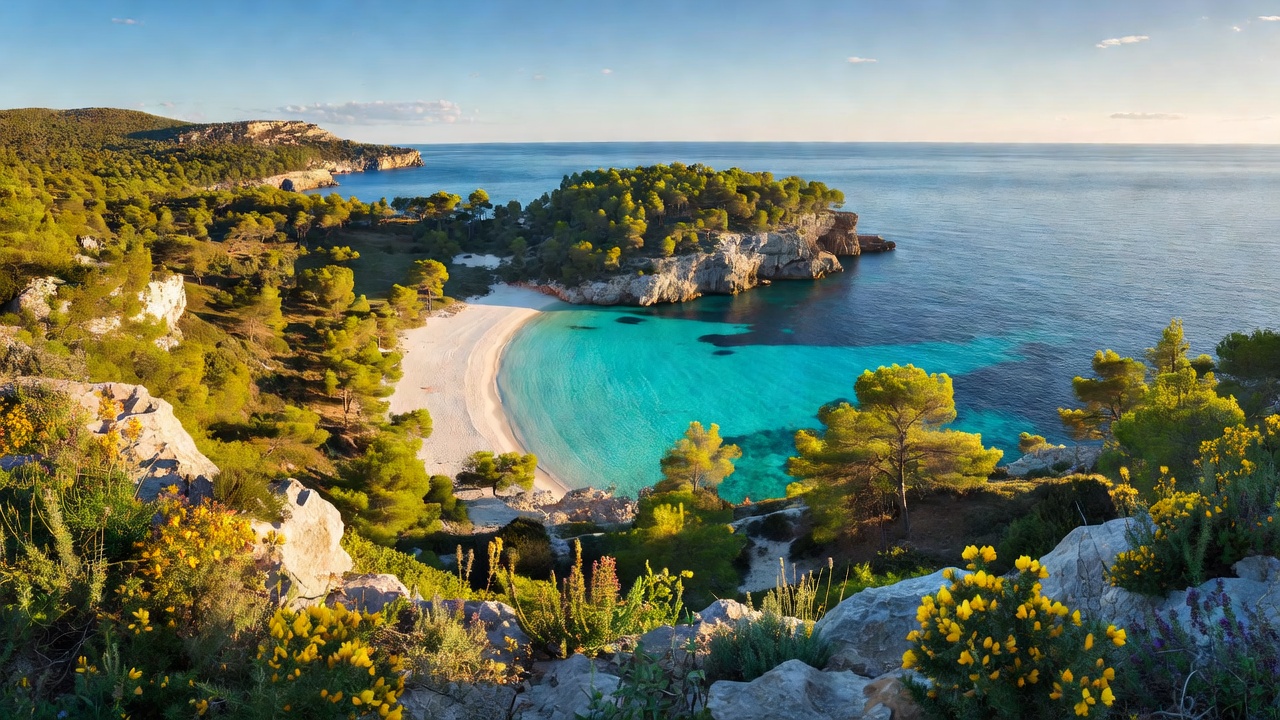
Official Characterization: Documented in Spain's official tourism portal as a white-sand beach protected by cliffs, with calm waters and a relatively isolated setting, Cala Macarella presents photographers and naturalists with an exceptional tapestry of contrasting geological and botanical textures.
Mastering the Light: When and How to Photograph
Capturing the electric turquoise hue of Cala Macarella requires an understanding of solar elevation and water reflection. Unlike mountain landscapes where sunrise and sunset provide the standard golden hour, coastal waters over shallow carbonate sand respond distinctively to varying angles of incidence:
- Midday Overhead Light (11:30 to 14:30): The highest sun angles penetrate the water column vertically, eliminating surface glare and revealing the true neon-aquamarine luminescence over the white seabed. Using a circular polarizing filter (CPL) cuts surface reflections and illuminates anchored boats casting clean shadows on the bottom.
- Golden Sunset Glow (18:30 to 20:30): As the sun dips toward the western Mediterranean horizon, the warm limestone cliffs ignite in tones of ochre, peach, and coral. The sea transforms from sharp turquoise into deep metallic copper and lavender.
Top 3 Elevated Photography Vantage Points
1. The Western Ridge to Macarelleta
Ascending the coastal trail toward Cala Macarelleta offers the most famous postcard vista. Looking back eastward, you capture the entire amphitheater: the deep cove mouth, the pine canopy, and the crescent sand strip framed by vertical limestone.
2. The Eastern Camí de Cavalls Lookout
Perched along the high trail arriving from Cala Galdana, this elevated promontory gazes westward directly into the inlet. It is the premier location for early morning light when the sun rises behind you, casting soft illumination across the water.
3. Shoreline Level at the Eastern Cliff Footing
At water level, positioning your camera near the eastern rock formations creates a compelling foreground element. The weathered calcarenite textures, with small natural hollows and miniature tidal shelves, lead the viewer's eye into the transparent shallows and the open mouth of the cove.
Flora: From Maritime Dunes to Dense Pine Ravines
The ecological transition across Cala Macarella is an exemplar of Menorcan botanical zoning. The microclimate within the ravine (barranc) retains moisture significantly longer than the windswept coastal plateau, supporting diverse plant communities:
Dune Pioneers: Directly behind the beach berm, the delicate Sea Daffodil (Pancratium maritimum) produces large, scented white blooms in late July and August. Accompanying it is the hardy Sea Holly (Eryngium maritimum), whose waxy, spiny leaves retain vital freshwater reserves against desiccating sea spray.
Aleppo Pine Woods: The surrounding hillsides are carpeted by resilient Aleppo pines (Pinus halepensis). Many of these trees grow directly out of sheer rock clefts, twisted by coastal winds into dramatic sculptural forms. Their resinous scent mingles with the salty Mediterranean air, defining the sensory identity of the cove.
Garrigue Understory: Beneath the pine canopy thrives dense shrubbery consisting of mastic (Pistacia lentiscus), wild olive (Olea europaea var. sylvestris), rosemary, rockrose (Cistus), and sweet-scented myrtle.
| Ecological Zone | Dominant Plant Species | Key Wildlife Inhabitants | Conservation Status |
|---|---|---|---|
| Submerged Marine Bed | Posidonia oceanica (Neptune Grass) | Saddled seabream, octopus, cuttlefish | Strict EU Habitat Directive |
| Coastal Sand Berm | Sea Daffodil, Sea Holly, Sand Spurge | Pioneer beetles, coastal shorebirds | Restoration zone; fenced off |
| Limestone Cliff Faces | Samphire (Crithmum maritimum) | Audouin's gull, peregrine falcon, swifts | Protected cliff nesting sector |
| Ravine Pine Woods | Aleppo Pine, Mastic, Wild Olive | Balearic warbler, pine marten, nightingales | Natural Area of Special Interest (ANEI) |
Fauna of the South Coast Ravine
Menorca was designated an official UNESCO Biosphere Reserve in 1993, and Cala Macarella serves as a key biodiversity hub. In the skies above the limestone cliffs, observant visitors can spot the graceful silhouette of Audouin’s Gull (Ichthyaetus audouinii), a vulnerable seabird species endemic to the Mediterranean that feeds on surface fish.
High vertical cliffs also provide secure nesting platforms for Peregrine Falcons (Falco peregrinus) and European Shags. In the dense pine thickets bordering the ravine stream, nightingales serenade early morning hikers, while elusive European pine martens forage quietly through the forest floor.
Under the waves, the healthy Posidonia beds provide vital nursery grounds for hundreds of species of juvenile fish, sea urchins, and invertebrates. Respecting this fragile ecological balance ensures that Cala Macarella remains a thriving sanctuary for generations of travelers and naturalists to come.